
How Agentic AI Can Make Healthcare Operations Safer
Executive Summary
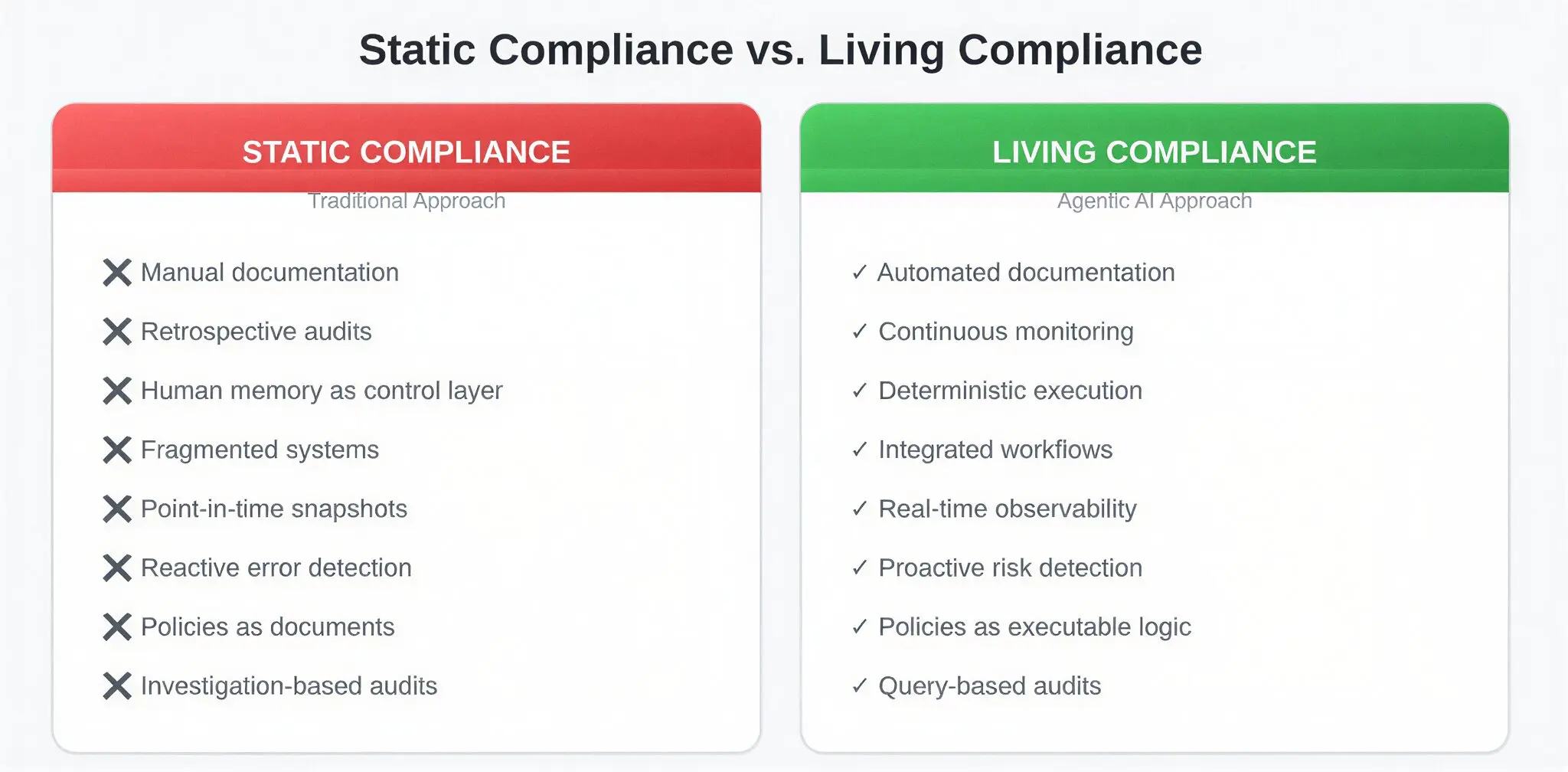
Healthcare compliance today is manual, retrospective, and brittle. Humans are expected to remember rules, document decisions, and reconstruct context months later during audits. The result is a system that doesn’t scale—one where patient safety, operational efficiency, and regulatory defensibility are perpetually at risk.
Agentic AI offers a fundamentally different approach. When designed with deterministic execution, constrained autonomy, and human-in-the-loop oversight, these systems enable continuous, auditable, real-time compliance. The result is not less control, but more.
This paper presents a joint legal and technical perspective on how healthcare organizations can transform compliance from a periodic burden into an always-on operational advantage—without venturing into clinical decision-making or creating new liability exposure.
1. The Compliance Reality Today
Walk into any healthcare organization and you’ll find the same pattern: compliance lives in binders, spreadsheets, and the institutional memory of overworked staff. Regulatory requirements from HIPAA, CMS, state licensing boards, and payer contracts create a web of obligations that must be tracked, documented, and proven during audits that can occur months or years after the fact.
The fundamental problem is that human memory serves as the primary control layer. Staff must remember which forms require signatures, which authorizations need renewal, which coding guidelines changed last quarter, and which payer requires which documentation. When they forget—and they inevitably do—organizations face denied claims, audit findings, regulatory penalties, and in worst cases, patient harm.
Current systems are fragmented by design. Electronic health records handle clinical documentation. Practice management systems handle billing. Separate platforms manage credentialing, contracting, and quality reporting. Each system maintains its own version of truth, and reconciling them requires manual effort that rarely happens until an auditor demands it.
The result is retrospective compliance—organizations discover problems only when claims are denied, audits are scheduled, or regulators come calling. By then, the context that would explain decisions has evaporated, the staff who made those decisions may have moved on, and reconstruction becomes an expensive forensic exercise.
2. What Changes with Agentic AI
Agentic AI represents a category shift from the chatbots and predictive analytics that have characterized healthcare’s AI adoption to date. Where traditional AI systems respond to queries or flag patterns, agentic systems act: they pursue goals, execute workflows, and interact with other systems—all within defined boundaries.
The distinction matters for compliance. A chatbot can tell a biller that a claim might be denied. An agentic system can validate that claim against payer requirements before submission, flag specific deficiencies, gather missing documentation, and either route for human review or proceed based on pre-defined rules. The compliance check becomes embedded in the workflow rather than layered on top of it.
This is what we mean by “compliance by design.” Instead of writing policies that humans must remember to follow, organizations encode those policies into executable logic that agents enforce automatically. The question shifts from “Did staff follow the policy?” to “Is the system configured correctly?”—a question that can be answered definitively and audited systematically.
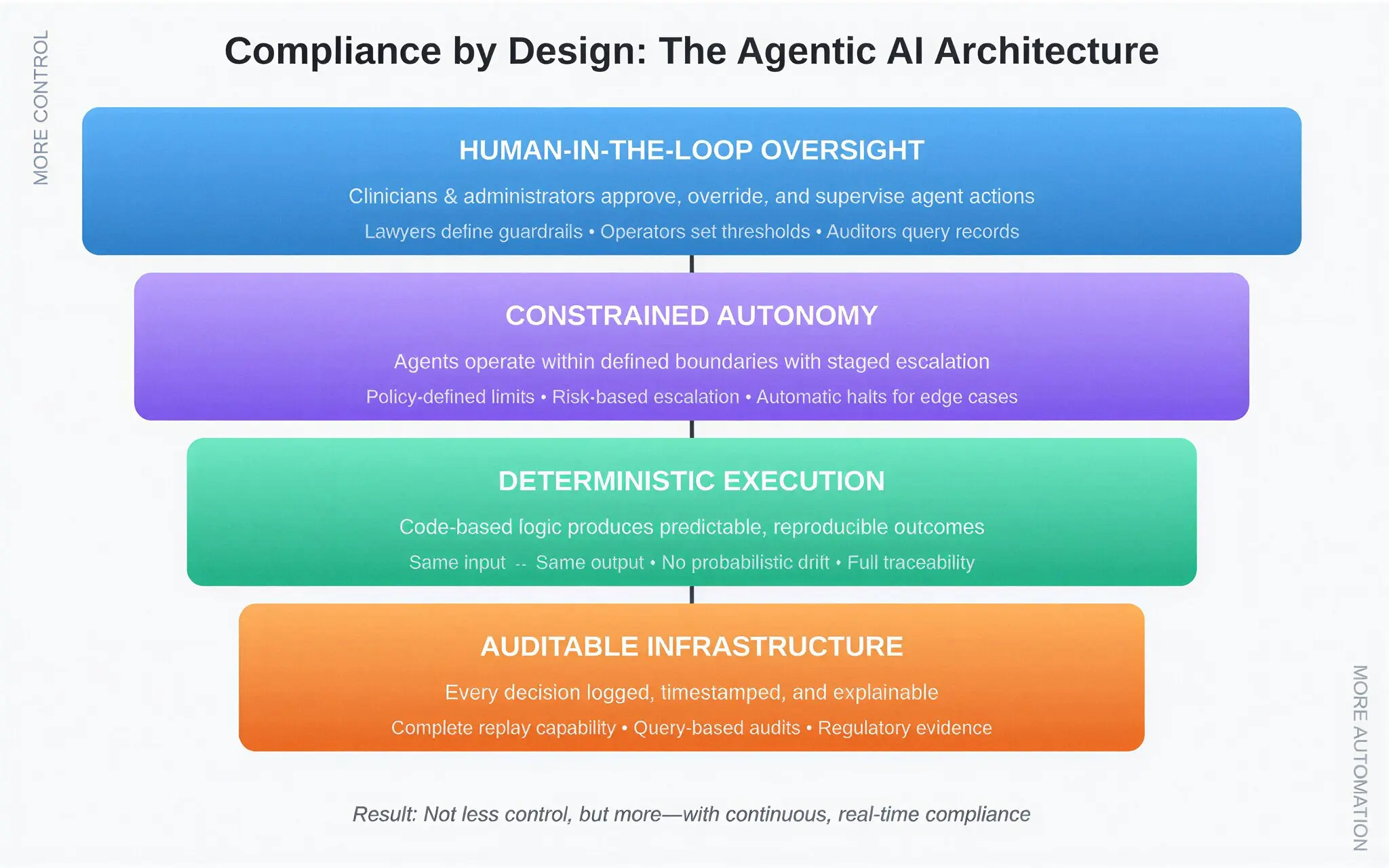
Critically, effective agentic AI for compliance requires three architectural commitments: deterministic execution (the same inputs produce the same outputs), constrained autonomy (agents operate only within defined boundaries), and human-in-the-loop oversight (humans retain authority over consequential decisions). Without these, organizations simply trade one set of risks for another.
3. Safety, Accuracy, and Accountability
Healthcare leaders approaching agentic AI consistently raise three questions: What happens when the AI is wrong? Who is accountable? Can we explain this in an audit? These questions deserve serious answers, not dismissive assurances.
Deterministic vs. Probabilistic Systems
Large language models generate responses probabilistically—the same prompt can produce different outputs. This creates obvious problems for compliance, where consistency and predictability are paramount. Deterministic agentic systems address this by separating natural language understanding from execution logic.
Human-in-the-Loop Governance
Staged autonomy addresses the accountability question. For low-risk tasks agents can act autonomously, while higher-stakes decisions require human approval.
Explainability and Replay
For audit defensibility, every agent action must be logged with sufficient context to reconstruct why it happened.
4. From Policies to Systems
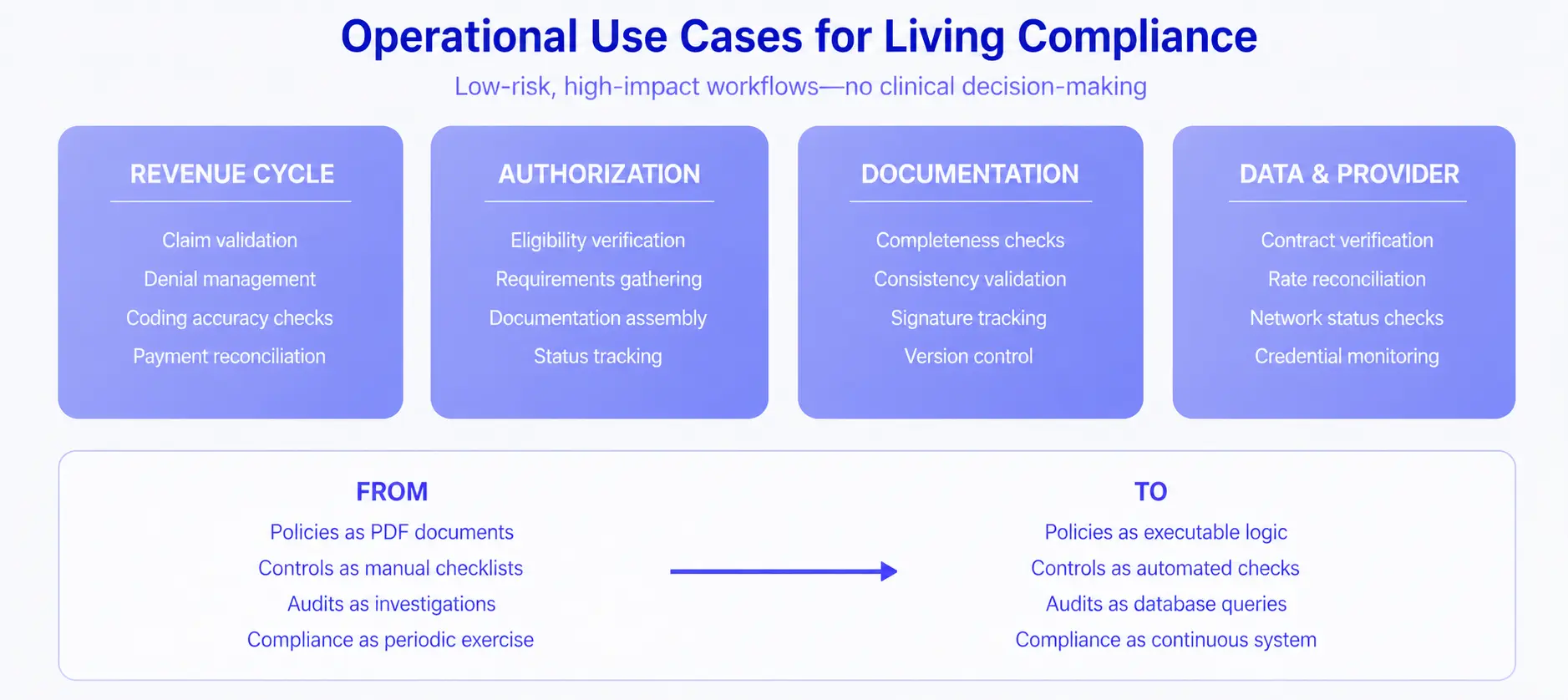
The most profound shift that agentic AI enables is the transformation of compliance from documentation to infrastructure.
Policies become executable logic. Consider a payer contract that requires prior authorization for certain procedures. The system evaluates this automatically.
Controls become automated checks. Manual compliance checklists become automated validations.
Audits become queries. Compliance checks become instant queries instead of long audits.
5. Practical Use Cases
Revenue cycle workflows offer immediate opportunities. Agents can validate claims, manage denials, and reconcile payments.
Prior authorization is a high-impact application. Systems can handle verification, documentation, and tracking.
Documentation integrity benefits from continuous monitoring.
Payer-provider data alignment ensures accuracy across systems.
Conclusion
Healthcare compliance doesn’t have to be a periodic scramble. Agentic AI can transform it into continuous, reliable infrastructure.
Compliance stops being a document. It becomes a system.
About the Authors
Natasha Allen is a partner at
Foley & Lardner LLP, specializing in healthcare regulatory compliance and AI strategy.
Sam de Brouwer is co-founder and CEO of
XY.AI (XYCorp Ltd), focused on agentic AI for healthcare operations.
Lamara de Brouwer is co-founder and CTO of
XY.AI (XYCorp Ltd), leading engineering for auditable systems.
Louis Lehot is a partner at
Foley & Lardner LLP, advising on healthcare technology, governance, and AI implementation.